Why Your Kid's Music Education Budget Is Working Against Itself
Let's do a quick thought experiment. Grab a pen and add up every music-related charge hitting your bank account this month. Private lessons? Probably $80–$120. A practice app like Simply Piano or Playground Sessions? Another $10–$20. Sheet music from Musicnotes or a Hal Leonard subscription? Maybe $8–$15. Instrument rental from your local music shop? Anywhere from $20 to $50. Throw in a metronome app, a theory workbook from Amazon, and a YouTube Premium subscription so your kid can watch tutorials without ads — and you're quietly burning through $175 to $200 a month on music education.
Now ask yourself: can your kid play anything they couldn't play three months ago?
For a lot of families, the honest answer is barely. And that's not because the tools are bad. It's because the tools were never designed to work together — and nobody told you that when you signed up for all of them.
The Fragmentation Problem Nobody Talks About
Music education has a spending fragmentation problem that's almost invisible until you lay everything out side by side. Unlike, say, a math tutoring platform that tracks quiz scores and adjusts difficulty, the typical music learning setup for a kid is a loose collection of services that don't communicate with each other at all.
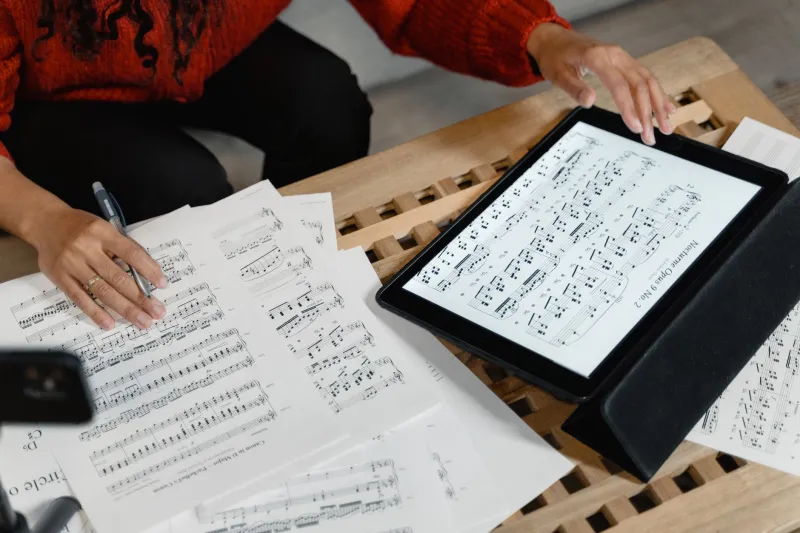
Your private teacher assigns a Bach minuet. Your practice app is drilling chord progressions from a completely different curriculum. The sheet music you bought on Musicnotes is for a pop song your kid wanted to learn. And the YouTube tutorials they're watching are from a guy in the UK who teaches jazz voicings to adults.
Every one of those resources has value in isolation. Together, they create noise. The kid doesn't know what to practice. The parent doesn't know what progress looks like. And the monthly bill keeps compounding.
This is what we'd call a redundancy trap at EdPriceList — you're paying for the same type of value (music instruction) multiple times over, just from different vendors who each claim to be the missing piece.
What You're Actually Paying For (And What Overlaps)
Let's break down the typical music education stack and be honest about where the overlap lives.
Private lessons ($80–$120/month): This is your highest-value line item, assuming you have a good teacher. A skilled instructor provides real-time feedback, catches bad habits early, customizes the curriculum, and provides accountability. This is hard to replicate digitally.
Practice apps like Simply Piano, Flowkey, or Playground Sessions ($10–$20/month): These are essentially gamified self-paced lesson platforms. They use your device's microphone to detect notes, offer guided song libraries, and track streaks. Here's the thing — if your kid has a private teacher and one of these apps, they're likely following two different curricula simultaneously. The app doesn't know what the teacher assigned. The teacher doesn't know what the app is drilling.
Sheet music subscriptions ($8–$15/month): Platforms like Musicnotes Pro give you unlimited downloads. But most practice apps already include a built-in song library of hundreds of pieces. And your teacher almost certainly has physical books or PDFs they prefer. That's three potential sources of sheet music — and you might only need one.
Instrument rental ($20–$50/month): Rental makes sense early on, especially before you know if the kid will stick with it. But rental programs often include rent-to-own clauses that quietly become a worse deal than outright purchasing a starter keyboard after month eight or nine. Many families never do that math.
Theory apps, workbooks, YouTube ($0–$15/month): Often the most overlooked category. A lot of parents add these because the teacher mentioned "music theory" once and the parent Googled it. But a competent private teacher is already weaving theory into lessons. You might be paying for content your teacher is covering for free.
A Framework for Cutting the Overlap Without Cutting Progress
Here's the thing — you don't need to spend less on music education. You need to spend more intentionally. That usually means spending less.
Start with your teacher. If you have a private instructor you trust, they should be the anchor of your system. Ask them directly: what supplemental tools, if any, do they recommend? Many teachers actively dislike certain apps because they teach bad technique or conflicting fingering habits. Some love Flowkey for practice accountability between sessions. Get their opinion before you subscribe to anything.
Pick one app and commit to it — or drop them all. If your teacher doesn't recommend a specific practice app, and your kid isn't using the one you're paying for consistently, cancel it. A $15/month app your kid opens twice a week is a $90 distraction over six months. If you do use an app, treat it as a practice accountability tool, not a second teacher.
Audit your sheet music sources. If you're paying for a Musicnotes subscription and your kid is using a practice app with its own library and your teacher provides materials, you're almost certainly over-covered. Drop the sheet music subscription unless you have a specific, ongoing need for it.
Run the rental math. Take whatever you're paying monthly for instrument rental and multiply it by 12. If that number is within $100–$200 of a decent entry-level instrument — a Yamaha P-45 digital piano runs around $500, for example — it's probably time to buy. You'll own the instrument, stop paying monthly, and your kid gets something that's actually theirs.
Define what progress looks like. This is the part most families skip entirely, and it's the reason money keeps flowing without results. Sit down with your teacher and agree on a measurable three-month goal. Can they play a specific piece hands together by March? Can they sight-read a simple melody? When you have a target, you can evaluate whether your current spending is helping you hit it — or just adding noise.
What a Leaner Setup Actually Looks Like
A family that does this audit seriously often ends up with something like: one private lesson per week ($90/month), one practice app their teacher endorses ($13/month), and a one-time instrument purchase instead of ongoing rental. That's roughly $103/month ongoing — down from $175–$200 — and the learning path is actually coherent.
That's not cutting corners. That's buying smarter.
Music education is genuinely worth investing in. But the industry is fragmented enough that it's easy to end up with a sprawling, expensive stack of tools that all technically teach music and none of which are talking to each other. The kid in the middle of that stack isn't getting $175 worth of progress every month. They're getting $175 worth of confusion.
Fix the system first. The money will follow.